Dubai, the pulsating heart of its namesake emirate, has evolved into a global powerhouse since the UAE’s founding in 1971. From its humble beginnings as a fishing and pearl‑diving village on the southern shores of the Persian Gulf, Dubai has strategically positioned itself as the Middle East’s preeminent entrepôt—often likened to Singapore and Hong Kong—for its seamless blend of commerce, culture, and cutting‑edge urbanism.
Origin of the Name
While the exact etymology remains debated, two dominant theories frame Dubai’s identity. One links the name to the local daba, a migratory locust once common to the region; another points to an ancient marketplace that catalyzed the city’s early mercantile momentum. Both narratives underscore Dubai’s evolution from a modest trading post to a world‑class metropolis.
Urban Character & Mosaic of Communities
Today’s Dubai is a high‑velocity melting pot—over 80% expatriate—with English serving as the de facto lingua franca amid Arabic’s official status. The city’s governance model fosters administrative efficiency and business‑friendly policies, driving scalable growth and an enviable reputation for low crime rates. Religious diversity thrives under a policy of tolerant coexistence: mosques stand alongside churches, Hindu temples, and Sikh gurdwaras, all integrated into Dubai’s cosmopolitan fabric.
Landscape Innovation: Shaping Shorelines and Skylines
Faced with limited natural beachfront, Dubai turned constraint into opportunity. Ambitious land‑reclamation initiatives birthed icons like Palm Jumeirah—an archipelago shaped like a palm frond—and the aptly named World Islands, a cartographic marvel visible from the air. The city’s shoreline expansion not only turbocharged tourism but also showcased Dubai’s capacity to rethink conventional urban planning.
Strategic Site & Modern Infrastructure
At its core lies Dubai Creek, a historical artery around which the earliest development concentrated. Today, this natural inlet’s banks are bookended by two distinct districts:
- Historic Bastakiya: Preserved wind‑tower dwellings and narrow lanes evoke Dubai’s pre‑oil era, offering cultural immersion and heritage learning.
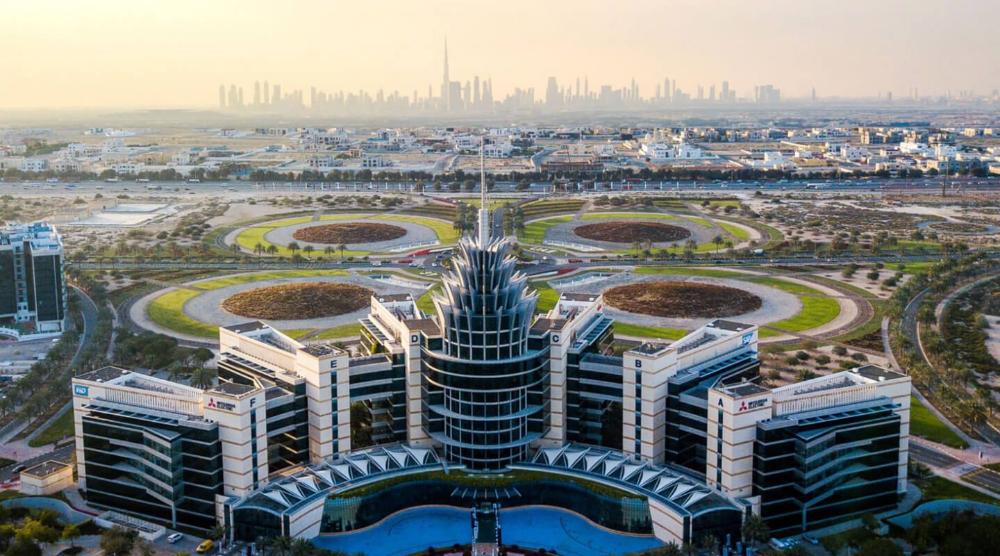
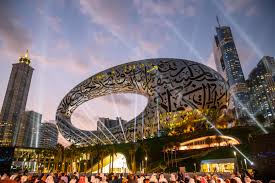
- Sheikh Zayed Road Corridor: A linear skyline of super‑tall towers—including the Emirates Towers, Dubai International Financial Centre’s signature arch, and the Burj Khalifa—demonstrates Dubai’s commitment to architectural innovation and financial services excellence.
Residential zones radiate westward, featuring luxury villas, the sail‑inspired Burj al‑Arab hotel, and man‑made marinas, all orchestrated to deliver lifestyle differentiation and high‑value real estate ROI.
Climate Dynamics
Dubai’s climate profile is a year‑round hot‑weather guarantee—high humidity in summer peaks above 40 °C (104 °F), while winter lows average a pleasant 15 °C (59 °F). This consistency underpins the city’s tourism and outdoor‑event ecosystems, allowing stakeholders to plan with confidence and maximize guest satisfaction irrespective of seasonality elsewhere.
The People: A Workforce Ecosystem
Dubai’s demographic trajectory reflects its strategic vision. Early growth was driven by nearby Gulf and Levantine merchants; later, large‑scale infrastructure and construction projects attracted a vast South Asian labor force. Today, skilled professionals from every continent contribute to sectors spanning finance, technology, hospitality, and logistics. While blue‑collar workers reside in dedicated labour camps beyond urban precincts, skilled expatriates integrate across residential communities—fueling a multi‑sector economy that hinges on both local stewardship and global talent influx.
Conclusion
Dubai’s relentless pursuit of innovation—whether engineering desert archipelagos or erecting the world’s tallest building—stems from a forward‑thinking ethos that values both its historical roots and its aspirational horizon. By synergizing heritage conservation with scalable urban expansion, Dubai has crafted a replicable model for cities poised at the intersection of tradition and tomorrow.
As you look beyond the dunes and glass‑clad spires, you’ll find a city that continuously reframes its narrative—inviting the world to witness how vision, resilience, and strategic execution can transform possibility into reality.